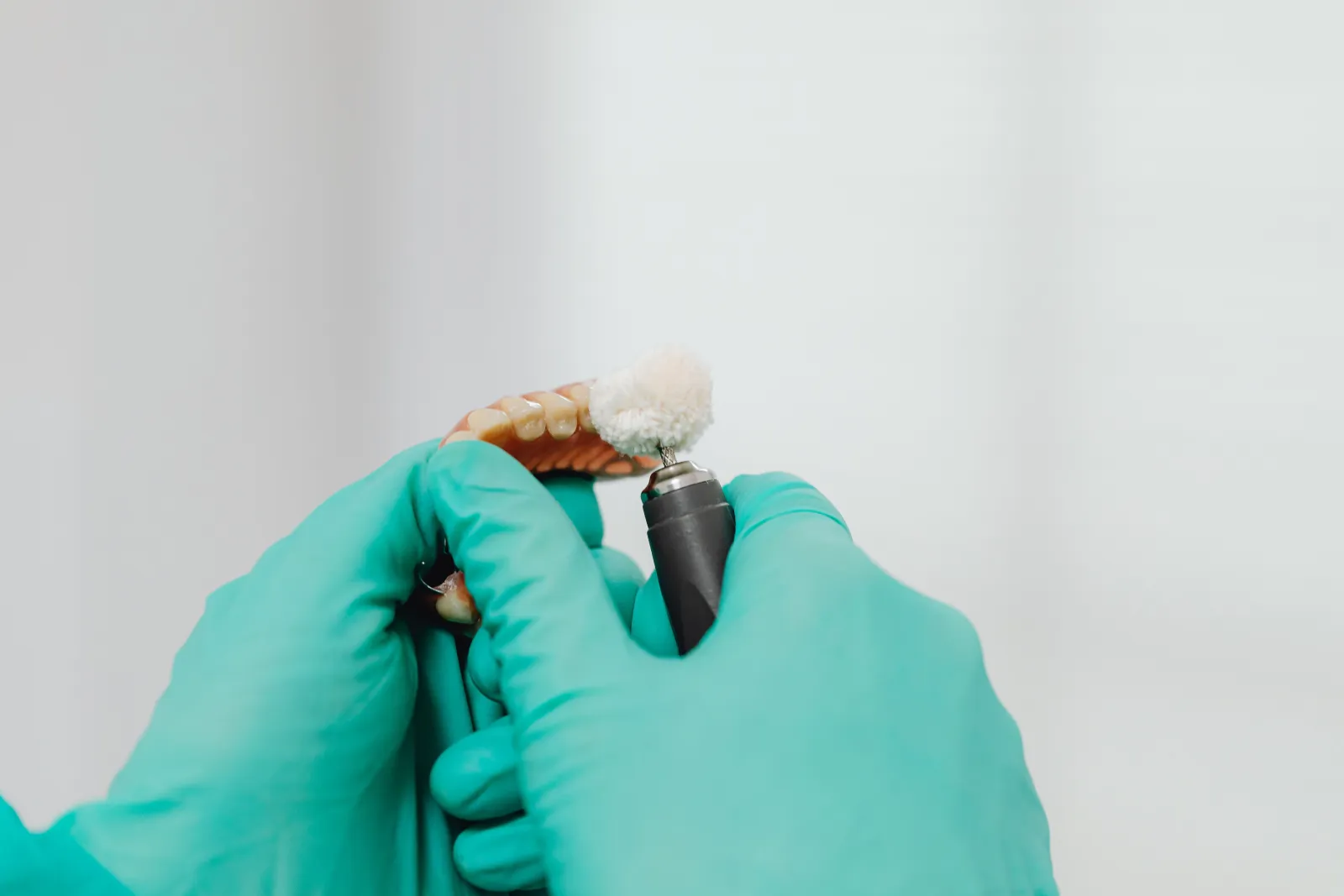
What decides the cost of dentures and partials? The American College of Prosthodontists (ACP) says denture fees vary widely with treatment complexity, the time required and the practice's location. England's National Health Service (NHS) adds that the type and the material change what private dentures cost. Your plan changes what you pay out of pocket. The exam and your plan settle most of it, so a number quoted before an exam is a guess.
What is the difference between a complete denture and a partial?
MedlinePlus, from the National Library of Medicine, says complete dentures cover your entire upper or lower jaw, while partials replace one or a few teeth. The ACP says a partial attaches to the teeth you still have and also rests on the gums and bone where teeth are missing. It adds that the number of missing teeth and their location affect a partial's comfort and stability.
What are dentures and partials made of?
The ACP says a removable partial is typically a metal framework with pink plastic to replace gum tissue, plus plastic or resin teeth. The American Dental Association (ADA) glossary defines the denture base as the part that touches the soft tissue and holds the artificial teeth. Ask which materials the quote assumes for the base and the teeth.
Why does a denture take more than one appointment?
England's NHS says the dentist measures your mouth and makes a mold, or sometimes scans it, and a later appointment fits the finished denture. The ADA says follow-up appointments are generally needed after a denture goes in, so the dentist can check and adjust the fit.
What if teeth have to come out first?
The ADA says a conventional denture is made and placed after the teeth are removed and the tissues have healed, which may take several months. Its glossary defines an immediate denture as one constructed for placement immediately after the remaining natural teeth are removed. The ADA says you don't have to be without teeth during healing. The denture may need to be relined or remade after the jaw heals. Removing teeth is its own procedure, so ask whether the quote includes it.
Why do dentures need adjusting, relining or replacing?
What changes in the mouth
The ACP says the bone that held the teeth often shrinks slowly after they are removed, though not for everyone. England's NHS says dentures may become loose as the gums and jawbone shrink or change shape as you get older.
What the dentist does about it
The ADA's glossary defines a reline as resurfacing the tissue side of a removable prosthesis with new base material. A rebase refits a denture by replacing the base material. The ACP says adjusting or relining a denture in good condition improves the fit. It also says dentures should typically be checked every year. Often they should be remade when they lose their fit and feel loose after 5 to 10 years of use.
Can dental implants make a denture more stable?
The ACP says dental implants can improve the stability and retention of complete dentures and can stabilize partials, per its dentures FAQ. It also says the lower denture is usually much less stable than the upper, because of its ridge's shape and the tongue's movement. MedlinePlus says that if dentures move too much, adhesive may help, and in some cases a dentist may suggest switching to dental implants.
What a 2021 review found
A 2021 systematic review compared lower dentures held by two implants with conventional lower dentures. It found better overall satisfaction, comfort, speech, chewing and stability with the implant-held denture, but no significant advantage in esthetics, and worse hygiene. The ACP also says the attachment parts can wear down and need replacing.
Surgery, healing and upkeep
Implants also mean surgery and a healing period. Our post on what decides the cost of dental implants explains how the post, the healing and any bone graft shape an implant quote. Ask whether your bone could hold implants without a graft, and what upkeep the attachments would need.
Does dental insurance cover dentures and partials?
The ADA's glossary defines an alternate benefit as a plan provision that bases payment on a generally less expensive procedure than the one proposed. It defines limitations as conditions in a benefit contract, such as age, length of time covered and waiting periods.
Who can tell you what your plan pays and what your quote includes?
Your plan's own terms decide what it pays, and the exam decides what a quote contains. When you call your plan, ask whether it covers dentures and partials as major work and whether a waiting period or yearly maximum applies. Ask whether it limits how often it pays to replace a denture, and whether it pays for relines and adjustments or toward an implant-held denture. When you get a quote, ask whether it includes removing teeth, the healing visits, the follow-up adjustments and a later reline.
Insurance checks and financing
Hanover Dental Care works with many dental plans, and the team checks coverage by phone at (804) 544-2499. For the part a plan does not pay, the practice offers financing through Cherry, CareCredit and Sunbit, plus an in-house savings plan. You can also visit our dentures and partials page.
Wondering what your plan covers? Call Hanover Dental Care in Montpelier at (804) 544-2499, or send a message through our contact page.